What to record when rental keys change hands
A calm, factual handover checklist for keys, access, condition, meters and open issues—so landlord, tenant and manager leave with the same record.
By RentRight Editorial DeskUpdated 10 August 20267 min read

A key handover is a small event with a long memory. Weeks later, people may disagree about how many keys were supplied, whether a wall mark already existed, which meter belonged to the flat or who promised to repair a leak.
The useful response is not a dramatic inspection report. It is a short, joint record of observable facts, created at the time of handover and shared with the people who need it.
Start with the event, not the condition list
At the top of the handover record, identify:
- the property address and exact unit;
- the date and approximate time;
- whether this is move-in, move-out, a manager change or replacement-key handover;
- the landlord, tenant, manager or representative present;
- the person giving the keys and the person receiving them.
If someone signs or acknowledges the record on another person's behalf, state the role. Do not describe an agent, caretaker or family member as the owner unless that is the verified role you are recording.
Count access items by purpose
Do not write only “keys received”. Count and identify each item without recording sensitive codes in a widely shared file.
For example:
- two front-door keys;
- one bedroom key;
- one pedestrian-gate key;
- one vehicle-gate remote;
- one access card;
- no key supplied for the external store, pending clarification.
Test keys only where it is safe and authorised. If an item does not work, record that fact and the next action. If a code must be transferred, send it through the agreed private channel and note only that the transfer happened—not the code itself—in the general handover record.
Walk through the unit in the same order every time
Choose a simple route—entrance, living area, bedrooms, kitchen, bathrooms, balcony or external area—and use it consistently. That makes the record easier to compare at move-out.
For each area, note:
- doors, locks and windows;
- walls, ceilings and floors;
- taps, toilets, drains and visible leaks;
- lights, sockets and supplied appliances that can be tested safely;
- cupboards, wardrobes and fixed fittings;
- furniture or equipment included with the tenancy;
- signs of damp, cracks, pests or other visible issues;
- any area that could not be accessed or tested.
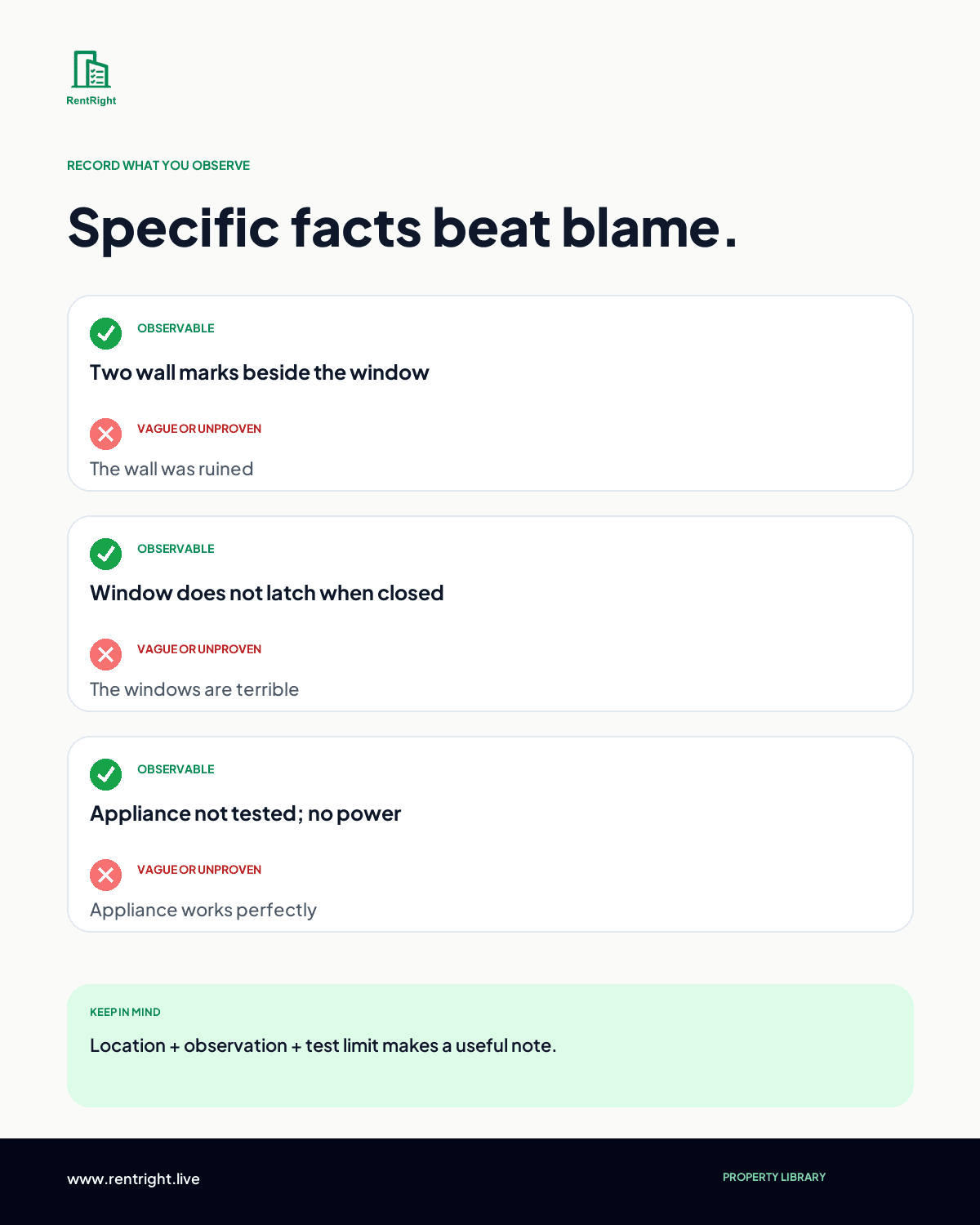
Describe what you can see or test. “Two dark marks on the living-room wall beside the window” is more useful than “wall damaged”. “Kitchen tap drips for about one minute after closing” is more useful than “bad plumbing”. A factual description does not decide who caused an issue or who must pay for it.
Record meters and services carefully
Where relevant, record the electricity meter or account identifier, its physical location and the visible reading or credit state. Do the same for a water meter or generator allocation if the property actually uses one.
Photograph the identifier and reading only if it is safe, permitted and useful. Make sure the image shows enough context to connect the meter to the unit. Do not open, alter, bypass or tamper with a meter.
Also record:
- the location of the unit's electrical breaker or safe isolation point;
- the water control or stop valve, if known;
- how shared services or service-charge issues are reported;
- any existing account, bill or credit question that needs follow-up;
- the authorised utility or property contact for that question.
A handover record preserves the opening position. It does not settle a utility debt, determine who legally owes it or replace the distributor's account record.
Use photos as evidence, not surveillance
Take only the images needed to show the unit, access item, reading or condition. A useful photo has context: a close-up of a crack plus a wider view showing which wall it is on.
Avoid capturing:
- identity documents, bank details or private messages;
- neighbours, children or workers who are not part of the record;
- door codes, Wi-Fi passwords or security-system details in a broad shared folder;
- unrelated personal belongings;
- images that have been filtered or edited in a way that hides the condition.
Section 24 of the Nigeria Data Protection Act 2023 includes principles of specified purpose, minimum necessary data, accuracy, storage limitation and security. Apply that discipline to handover photos: know why each image is needed, limit who can see it and do not keep unnecessary sensitive copies indefinitely.
Turn every open issue into a traceable next step
An issue list without an owner becomes a future argument. For each open item, record:
- the observable problem;
- the exact location;
- when it was reported;
- the person who accepted the follow-up;
- the next action and target date, if one was actually agreed;
- any safe temporary step already taken.
Do not invent a deadline that nobody agreed to. If responsibility is disputed, state that the issue is recorded and responsibility remains unresolved.
Use neutral language
The record should separate observation from judgment.
Useful patterns include:
- Location + observation: “Bedroom 1 window does not latch when closed.”
- Count + condition: “Three front-door keys supplied; all opened the lock during the handover.”
- Test limit: “Air-conditioner present but not tested because electricity supply was unavailable.”
- Open question: “Meter account name not confirmed at handover; manager to provide the current account record.”
- Correction: “Earlier note said two gate keys; both parties counted three. Corrected at 15:20, with the earlier note retained.”
Avoid conclusions such as “tenant ruined”, “landlord neglected” or “brand new” unless the record contains reliable evidence and the wording is necessary. A handover checklist is not the place to decide a legal dispute.
Share and acknowledge the same version
At the end, both sides should be able to review the same record. An acknowledgement can confirm that the record was received and reviewed; it does not have to mean that every legal issue is resolved.
Before leaving, check:
- the names, roles, property and unit are correct;
- the key count matches the items physically handed over;
- photos are attached to the correct room or issue;
- meters and service identifiers are connected to the right unit;
- open issues have an honest status and named follow-up;
- both sides can access a copy;
- any correction is dated and the earlier version remains traceable.
Store the handover record with the agreement and later maintenance updates, while keeping each document's job clear. The agreement records the tenancy terms; the handover records what happened at a particular time.
Common mistakes
- Completing the checklist before seeing the unit.
- Using one key count for several units or shared gates.
- Writing blame instead of an observable condition.
- Taking close-up photos with no room or location context.
- Recording meter digits without confirming which flat the meter serves.
- Putting access codes or identity documents in a broad chat group.
- Treating “acknowledged” as proof that every issue is accepted or resolved.
- Editing the only copy after the handover without a correction trail.
The smallest useful handover record
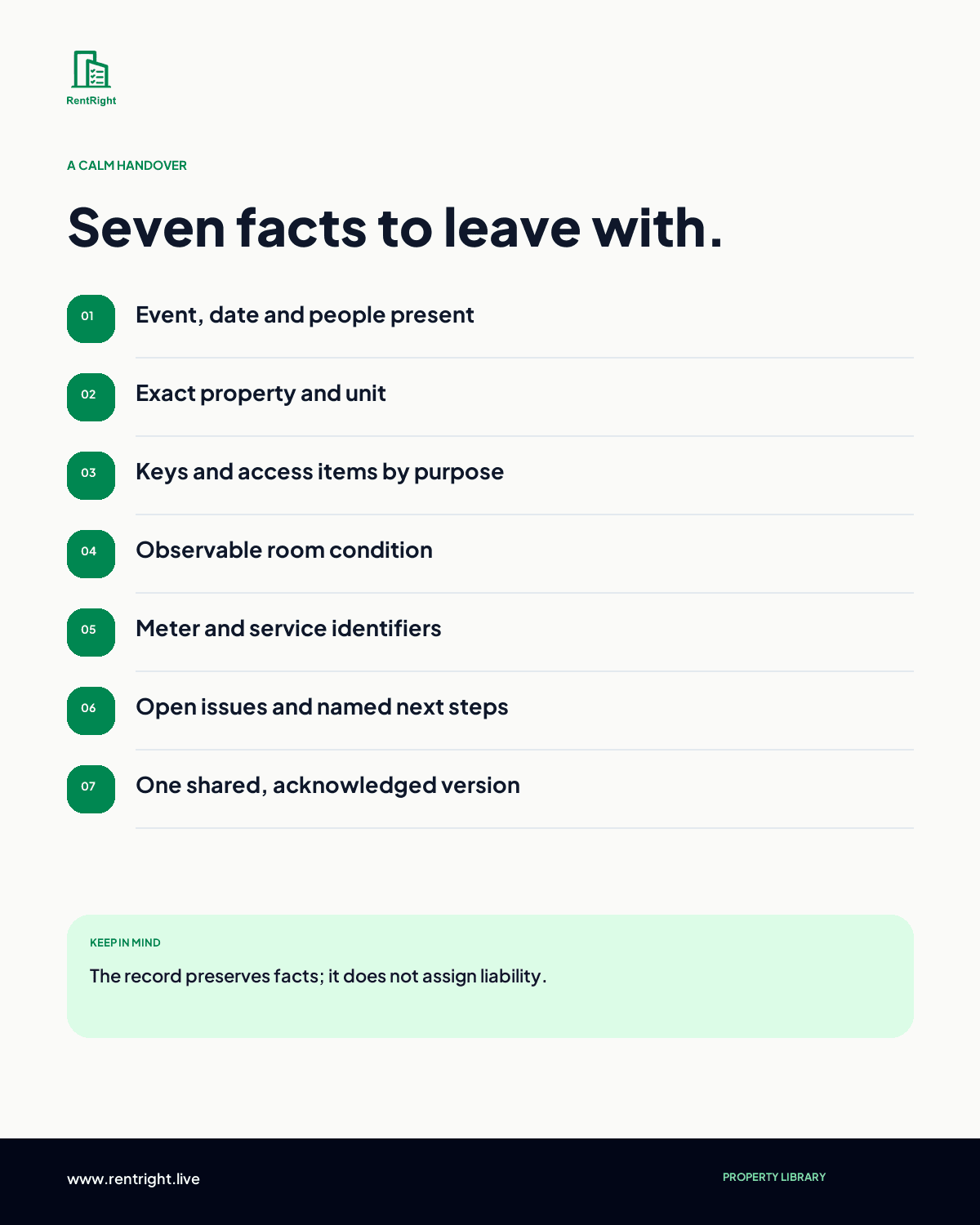
If time is limited, capture seven things: event, people and roles, exact unit, access-item count, observable condition, meter/service identifiers, and open next steps. Share the record promptly and correct errors transparently.
That small discipline gives landlord, tenant and manager a common starting point without turning the handover into a product pitch or a legal performance.
Keep the property, unit, handover notes and later maintenance history connected in one shared rental record.
Put this guide into practice
Sources
- Nigeria Data Protection Commission — Nigeria Data Protection Act 2023Accessed 8 August 2026 · See section 24 for data-processing principles including purpose limitation, data minimisation, accuracy, storage limitation and security.
- RentRight — product workflow and feature documentationAccessed 8 August 2026 · Product evidence reviewed in the current repository on 8 August 2026. Used only for the bounded CTA and shared-record description.